Selling AI art on Etsy: the rule that removes shops
Etsy does not ban AI-generated art. It requires three things: you disclose in the listing description that AI was used, you list yourself as the designer because you directed the output, and you do not infringe on copyrighted characters, names or styles. The penalty for skipping disclosure is listing removal without warning, and Etsy removes listings for exactly this. Selling AI art is allowed; selling it as if a human made it by hand is not.
Last updated: 2026-10-08
Etsy allows AI art, and enforces disclosure hard
The fear behind this search is that Etsy has started banning AI art. It has not. What it has done is draw a line between selling AI art honestly and selling it as handmade, and it enforces that line by removing listings.
Etsy's Creativity Standards allow generated art under three conditions. You disclose that AI was used, in the listing description and the attribution. You list yourself as the designer, because you wrote the prompts and directed the output. And you do not infringe on copyrighted characters, names or artistic styles. Meet those three and a generated listing is inside the rules; miss the disclosure and it is removed, often with no warning.
The risk is concrete: Etsy removes listings for getting the disclosure wrong, and no pass rate or removal count is published on this page.
The three conditions, one by one
- Disclosure. A clear line in the listing description, plus the attribution set to "Designed by" with yourself as the designer. There is no exemption for a small amount of AI or for AI-assisted editing.
- Creative direction. You wrote the prompt and guided the output. Running someone else's prompt through a generator is not your own direction, and Etsy treats that as the button-pushing it does not credit.
- No infringement. Characters, names and styles that belong to someone else are out, the same as for any other listing.
The common failure is the first one, not the second or third. Sellers under-disclose to avoid hurting conversion, and it costs them the listing.
What Etsy's detection actually looks at
Etsy's enforcement is layered, and that matters because it tells you why cleaning a file is not a complete answer.
- Metadata. The file is read for AI tool signatures written by the generator. This is the layer a naturalization pass addresses.
- Visual recognition. The image itself is checked for characteristics common to generated art.
- Cross-reference. Listings are compared against databases of known generated images.
- Behaviour. Upload frequency and the similarity between a seller's listings are watched for bulk generation.
A file with clean provenance still faces the visual, cross-reference and behavioural layers. This is not a single check that one operation defeats; it is a system that the disclosure rule is designed to work alongside.
What PassReal changes, and what it does not
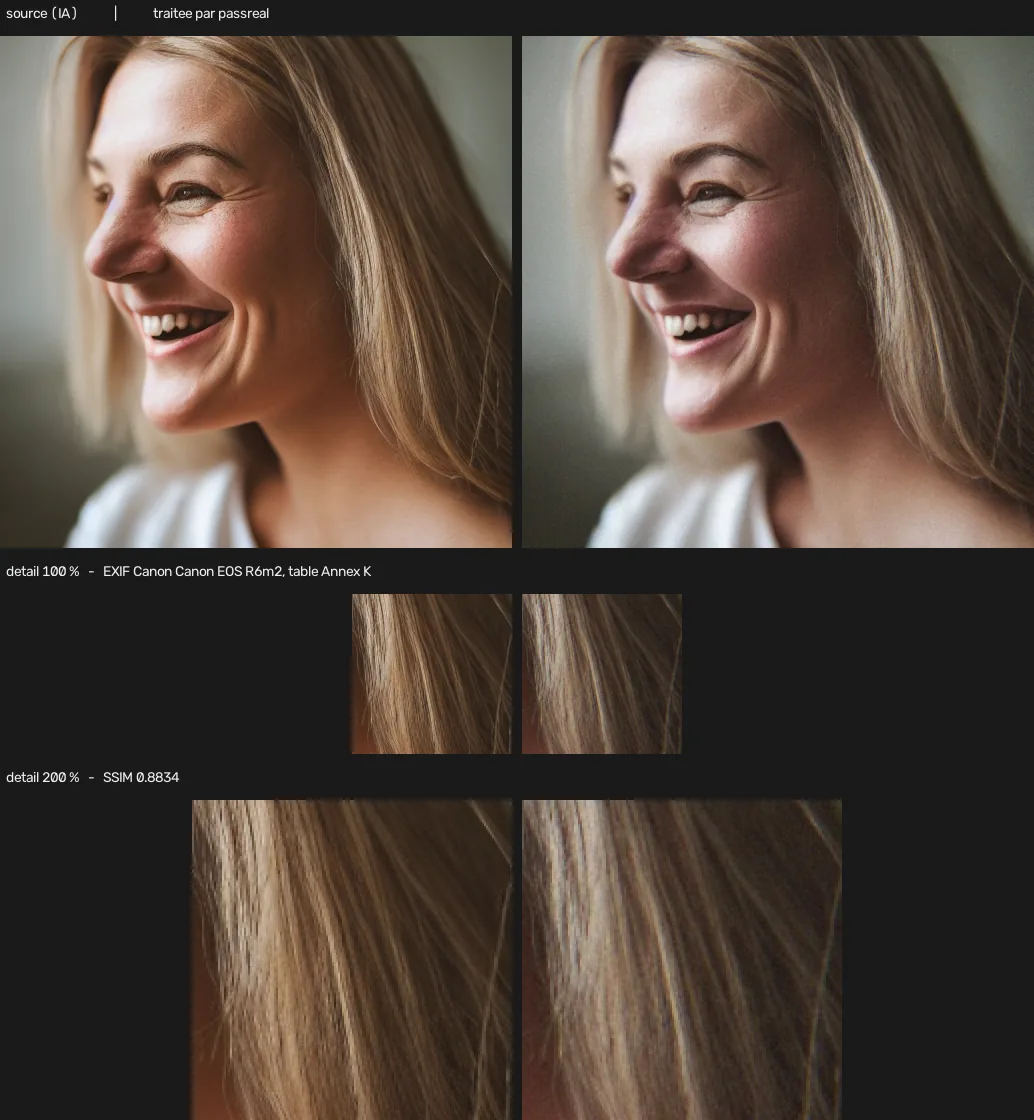
PassReal strips the provenance a generator writes and rewrites the file as camera output, with coherent EXIF and a matching quantization table. For the metadata layer of Etsy's detection, that is the complete fix: a file that no longer declares a machine origin has nothing for that check to read.
What it does not change is the rest of the system. The visual layer still looks at the image. The cross-reference layer still compares it to known generated images. And the disclosure requirement is not touched by any file processing, because it lives in the listing, not in the pixels.
On Etsy the honest path is also the durable one. Disclose that the work is AI, credit yourself as the designer because you directed it, and let PassReal handle the file itself so it does not carry an avoidable signature.
The playbook that keeps a shop alive
The sellers who last on Etsy treat disclosure as a feature, not a confession.
- Put a clear line in the description saying AI was used and how you directed it.
- Set the attribution to "Designed by" with yourself as the designer.
- Make the work recognisably yours rather than raw generator output.
- Keep the file honest at the provenance layer, which is where PassReal helps.
- Treat a removed listing as a disclosure or rights problem first, and read the reason before resubmitting.
The rule Etsy enforces hardest is not "no AI". It is "tell the truth about how this was made". Meet that, and the file-level cleanliness PassReal provides is the last polish rather than the whole strategy.
| What is checked | Value |
|---|---|
| Accepted formats | PNG, JPEG, WebP |
| Maximum size | 20 MB |
| Maximum dimension | 8192 px on the longest side |
| Sensor grain intensity | 0.018 |
| Lateral chromatic aberration | 1.25 px at the corners, none at the centre |
| Frequency cutoff | 0.88 of Nyquist |
Questions
Is selling AI art on Etsy allowed?
Yes, with conditions. Etsy permits AI-generated art if you provided the creative direction, meaning you wrote your own prompts and guided the output, as opposed to pushing a button on someone else's template. Buying someone else's prompts and running them through a generator does not count as your own creative direction.
Do I have to disclose that my art is AI?
Yes. Etsy requires a clear line in the listing description saying AI was used, plus the attribution set to "Designed by" with yourself as the designer. There is no exemption for small amounts of AI or for AI-assisted editing only. The penalty for skipping disclosure is listing removal, and it can come with no warning.
How does Etsy detect AI art?
Etsy uses a layered system: file metadata for AI tool signatures, visual recognition for common AI characteristics, cross-referencing against known generated images, and behavioural signals like upload frequency and listing similarity. A generated file with clean provenance still faces the visual and behavioural layers, which is why disclosure is the safer path than concealment.
Will cleaning metadata stop Etsy detecting my AI art?
It addresses only the metadata layer of a multi-layer check. Etsy also runs visual recognition and compares against known generated images, and human buyers can report a listing. A file with no AI signature still has to pass the visual and behavioural checks, and skipping disclosure is itself grounds for removal.
What is the safe way to sell AI art on Etsy?
Disclose it, credit yourself as the designer because you directed the output, and make the work recognisably yours. Sellers who build an original line and tell the truth have a more stable business than those chasing workarounds, because the disclosure rule is what Etsy actually enforces hardest.
What does PassReal change on an Etsy listing image?
It strips generation metadata and rewrites the file as camera output. That helps where a platform reads provenance fields. It does not replace the disclosure Etsy requires, and it does not change what a human reviewer or a visual detector sees. On Etsy, honesty in the listing is the part that keeps a shop alive.
Limits
Naturalization operates on the pixels and on the file, not on the content of the image. A subject that is implausible - six fingers, inconsistent reflections, text that does not read - stays implausible after processing, and a human reviewer will notice it. PassReal changes what a statistical classifier measures, not what a person sees.
Results vary by generator, by subject and by detector, and detectors are retrained. No pass rate is published on this page because none has been measured in a way that would still hold next month.
Three images, no card, no expiry.