Why Instagram and Facebook put an AI info label on a photo
Instagram and Facebook apply their automatic AI label mainly by reading industry provenance metadata, C2PA manifests and IPTC digital-source-type fields that generation tools write into the file, not by analysing the pixels. A file that carries neither field usually does not trigger the automatic label. Pixel watermarks such as SynthID are a separate detection layer and are not addressed by removing metadata.
Last updated: 2026-09-24
The label reads the file, not the picture
It is tempting to assume a platform inspecting an image for AI signs is looking at pixels: brush strokes, lighting, the too-smooth skin that gave away early generators. For Instagram and Facebook's automatic "AI info" label, that is mostly not how it works.
Meta has stated that the label relies primarily on industry standard signals embedded in the file: C2PA content credentials, a manifest format several major generators and camera makers now write by default, and IPTC digital-source-type fields, a metadata standard for recording how a media asset was produced. Both are text, sitting in the file alongside the pixels, not a judgement made by looking at the image.
This matters because it means the label is triggered by a declaration, and a declaration can be present on a file that would pass any visual inspection, or absent from a file that would fail one. The two are correlated in the common case, since a generator that writes C2PA is usually a generator, but they are not the same signal.
What actually writes the flagged fields
Three sources are common.
- The generator itself. Recent versions of the major image generators write a C2PA manifest by default, as part of an industry push toward labelling AI content at the source. This is the direct case: the tool that made the image also declared that it did.
- An editing step, not the generator. A photo taken with a real camera can pick up a C2PA assertion later, if it passes through an editor with a generative fill or object removal feature that writes its own provenance entry for that one edit. The file is now partly AI-touched by its own metadata, even if the visible change is a single removed object in one corner.
- A re-encode along the way. Messaging apps and some upload pipelines rewrite files in transit. Occasionally that rewrite preserves or adds a provenance field the original did not carry, which is a less common path but a real one, and hard to diagnose without reading the metadata directly.
Why a real photo sometimes gets flagged
This is the case that generates the most confusion, and it follows directly from the mechanism above. A photograph taken on a phone, edited in an app that has a generative feature, and exported, can carry a C2PA manifest recording that generative step, even though the vast majority of the frame is an unaltered photograph.
The platform is not wrong about what the metadata says. It is applying the label to what the file declares, and the declaration is technically accurate about the one AI-touched region, even when it reads, to the person who took the photo, as a mislabel of the whole image.
What removing metadata does and does not do
Stripping C2PA manifests and IPTC digital-source-type fields addresses the declared-provenance path directly. A file that no longer carries either field has nothing for that detection path to read, and in practice the automatic label tied to that path does not trigger.
What this does not touch is a separate layer: pixel watermarks such as SynthID, embedded in the image data at generation time rather than in a metadata field. A watermark of that kind is not removed by clearing metadata, and no claim to the contrary belongs in this guide or anywhere else. Platforms that check for pixel watermarks specifically, rather than declared metadata, are checking a different signal than the one described here.
Nor does removing metadata change what a human reviewer sees. If a platform escalates a labelled post to manual review, the reviewer is looking at the image, and a metadata strip has no bearing on that judgement.
Checking before you post
The fastest way to know what a file declares is to read it directly. exiftool -G1 -a image.jpg lists every metadata group and field, including any C2PA or digital-source-type entry if present. This takes under a second and answers the actual question, which is what the file says about itself, rather than guessing from how the image looks.
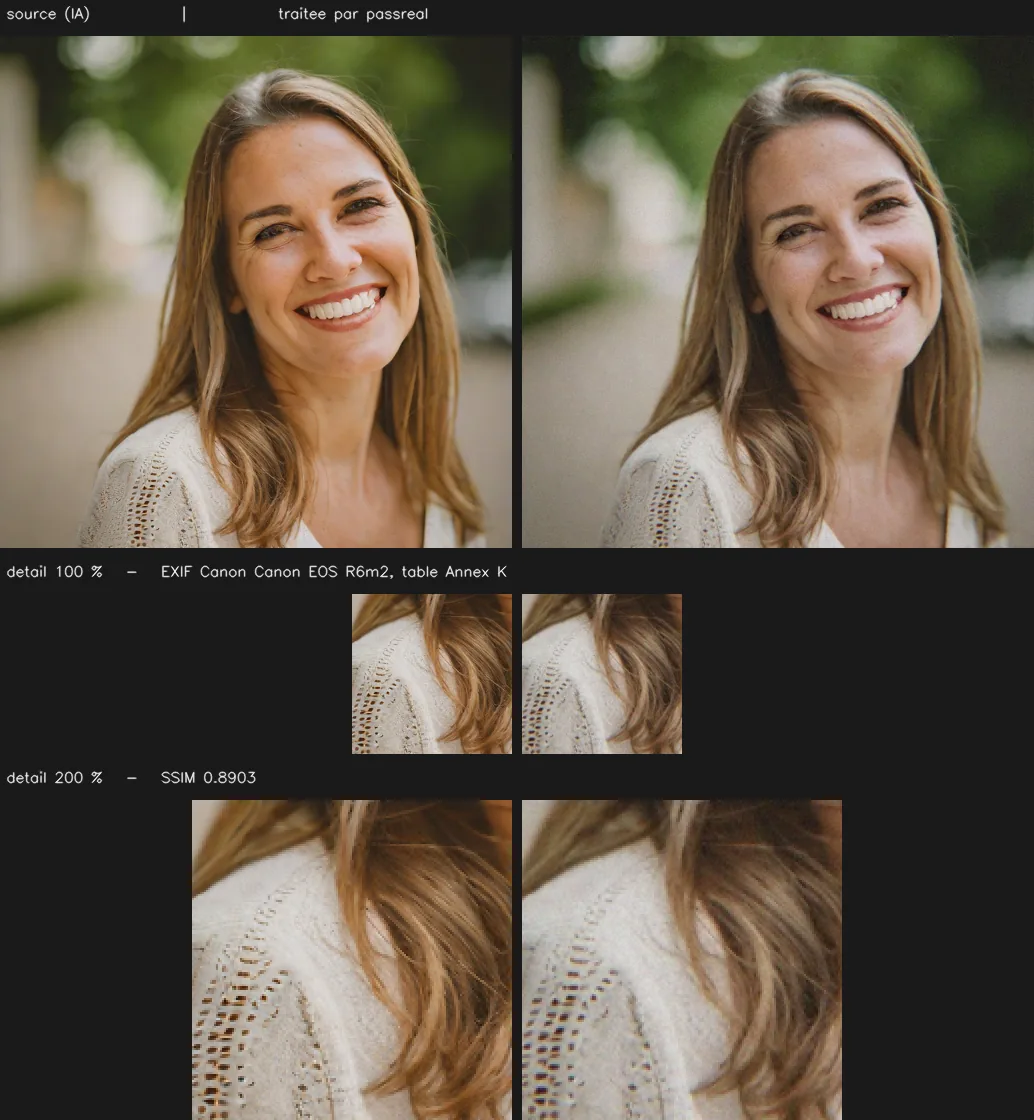
PassReal automates the removal for PNG, JPEG and WebP files up to 8192 px: it strips C2PA manifests, IPTC fields, XMP and PNG text chunks in one pass, then writes a coherent camera EXIF block so the result does not read as a file with its metadata simply deleted. The free plan gives 1 image now and 2 more once your email is confirmed, processing takes about a minute, and the pixel-watermark caveat above applies here exactly as anywhere else.
| What is checked | Value |
|---|---|
| Accepted formats | PNG, JPEG, WebP |
| Maximum size | 20 MB |
| Maximum dimension | 8192 px on the longest side |
| Sensor grain intensity | 0.018 |
| Lateral chromatic aberration | 1.25 px at the corners, none at the centre |
| Frequency cutoff | 0.88 of Nyquist |
Questions
What actually triggers the label
Meta has said its system relies primarily on signals it can read directly from a file: C2PA manifests and IPTC digital-source-type fields that record an image as machine generated. Both are metadata, written by the generator or by the platform the image passed through, not a visual judgement about what the picture shows.
Does Meta analyse the pixels too
Meta has described additional detection work beyond metadata, and the exact scope is not fully public. What is verifiable and repeatable is the metadata path: a file with a C2PA manifest or an IPTC digital-source-type field declaring AI origin reliably shows the label, and removing those fields reliably removes the trigger in that path.
Why did a real photo get labelled
Usually because it passed through an editor or an app that added a C2PA assertion for an unrelated reason, such as a generative fill tool used on one small area, or a messaging app that re-wrote metadata during a resend. The label reflects what the file declares, and a file can pick up a declaration from a single edit long after the photo itself was taken with a camera.
Does cropping or screenshotting remove the label trigger
A screenshot does, because it produces a new file with no metadata of its own. Cropping in most editors does not, because the editor preserves existing metadata by default and only changes the pixels. The label is triggered by what the file says about itself, not by what is visible in the frame.
Is SynthID removed by stripping metadata
No. SynthID and similar pixel watermarks are embedded in the image data itself, at generation time, and are a separate layer from C2PA or IPTC fields. Removing metadata addresses the declared-provenance path that triggers the automatic platform label. It makes no claim about a watermark embedded in the pixels.
What should I do before posting
Check what the file declares before you check what it shows. `exiftool -G1 -a image.jpg` lists every field, including any C2PA or digital-source-type entry, in under a second. If one is present and should not be, remove it before upload rather than after the label already appears, since some platforms cache the classification.
Limits
Naturalization operates on the pixels and on the file, not on the content of the image. A subject that is implausible - six fingers, inconsistent reflections, text that does not read - stays implausible after processing, and a human reviewer will notice it. PassReal changes what a statistical classifier measures, not what a person sees.
Results vary by generator, by subject and by detector, and detectors are retrained. No pass rate is published on this page because none has been measured in a way that would still hold next month.
Three images, no card, no expiry.