AI photos on Tinder: what gets you banned and what does not
Tinder does not ban AI-generated photos as a category. It bans misrepresentation: a profile that presents a face, age or body that is not recognisably the person who shows up. The practical gate is Photo Verification, which matches a live video selfie against your profile photos using facial geometry. A generated photo of your own real face can pass; a photo that changes your identity cannot, and no file processing changes that.
Last updated: 2026-10-04
The rule is not "no AI", it is "be you"
Search for whether Tinder bans AI photos and most of what comes back is wrong in the same way. Tinder does not have a rule against AI-generated or AI-enhanced images, and it has never published one. Read the actual guidelines and the words AI or generative never appear. What Tinder bans is misrepresentation: presenting a face, an age or a body that is not recognisably the person a match will meet.
This distinction matters more than it looks like it does, because it tells you what is actually risky. A generated photo of your own real face, at your current age and build, in a place you could plausibly be, is inside the rules. A generated photo of a younger, thinner or different-looking version of you is not, and it is the second kind that draws reports, review and bans.
The real gate is Photo Verification, not an AI detector
The mechanism that decides whether an AI photo hurts you on Tinder is not a pixel scanner. It is Photo Verification: Tinder asks for a short video selfie and matches it against your profile photos using facial geometry. If your profile photos look like the person in the selfie, you verify. If they do not, you fail, and unverified profiles are increasingly pushed down the algorithm even when no rule has been broken.
That is why the popular fear, "will Tinder detect my photo is AI", is aimed at the wrong target. The question that actually decides your outcome is whether your photos are recognisably you. A synthetic-looking photo of your own face is mostly a problem because it reads as a different person, not because a detector identified the model that rendered it.
What actually gets a profile banned
Four things do the work, in practice.
- A face that is not yours. Using someone else's photos, or a generated face, is impersonation. This is the fastest route to a ban and the one Tinder enforces hardest.
- A heavily altered version of you. Age, weight and feature edits that make you look like a different person fail verification and read as deception to anyone who swipes.
- Obvious synthetic tells. Extra fingers, warped ears, plastic skin and backgrounds that do not hold together get profiles reported, and reports pull a profile into human review.
- Photos that appear elsewhere. If an image reverse-searches to another profile, a stock asset or a public gallery, anti-fraud systems treat it as duplicated or stolen.
None of these is about whether a file was generated. They are about whether the profile is honest. A metadata-clean generated photo of your own face does not trip any of them, and a real stolen photo trips the first and the last immediately.
What PassReal changes, and what it does not
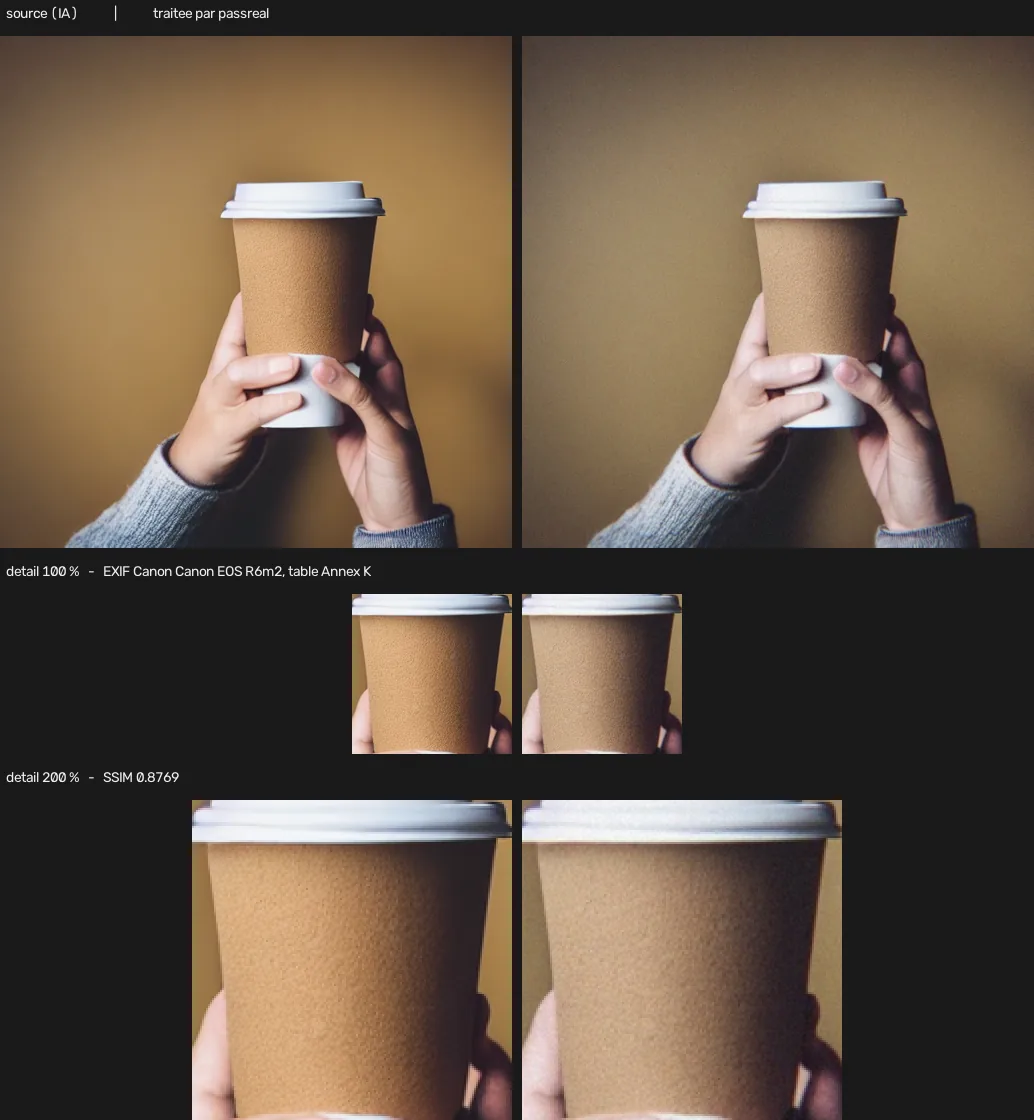
PassReal operates on the file and on the pixels, and that is a specific, honest scope. It strips the provenance a generator writes: C2PA manifests, IPTC digital-source-type fields, XMP blocks and PNG text chunks that declare an image as machine-made. It then applies a sensor model, a frequency pass and coherent camera EXIF with a matching quantization table, so the result reads as a photograph from a camera rather than as a generated file with its metadata simply deleted.
For the metadata-driven detection paths, that is the whole job. A file that no longer declares an AI origin has nothing for that check to read.
What it does not do is change identity. Facial geometry is not metadata and not pixel statistics; it is the shape of a face, and processing a file does not move it. If the person in your photo is not you, PassReal does not make them you, and no honest tool can.
The playbook that stays inside the rules
If your goal is a profile that passes verification and still gets the upside of polished photos, the working approach is straightforward.
- Generate from your real face, not an idealised one. The person in the selfie has to be the person in the photo.
- Mix generated and real shots. A line-up that is entirely synthetic reads as entirely synthetic; one or two candid, recent photos ground it.
- Keep the file honest at the metadata layer, which is where PassReal helps.
- Complete verification rather than avoiding it. A verified profile that reads as you outperforms an unverified one every time.
The rule is the same on Tinder as on every platform that checks AI content: the tool that made the image matters less than whether the image tells the truth about you.
| What is checked | Value |
|---|---|
| Accepted formats | PNG, JPEG, WebP |
| Maximum size | 20 MB |
| Maximum dimension | 8192 px on the longest side |
| Sensor grain intensity | 0.018 |
| Lateral chromatic aberration | 1.25 px at the corners, none at the centre |
| Frequency cutoff | 0.88 of Nyquist |
Questions
Does Tinder ban AI-generated photos?
No, not as a file type. Tinder's guidelines never mention AI or generative images. What they enforce is misrepresentation and impersonation: a photo that presents a face, age or body that is not recognisably you. A generated photo of your own real appearance is inside the rules; a glamorised or different version of you is what gets reported and removed.
Can Tinder detect that a photo is AI-generated?
Tinder does not publish a pixel-level AI detector, and its main enforcement path is not scanning images for generation artefacts. The two real mechanisms are Photo Verification, a video-selfie check matched against your photos, and user reports. Some automated checks also read the metadata a file declares, which is the layer PassReal addresses.
Can an AI photo pass Tinder Photo Verification?
Only if the person in it is recognisably you. Verification compares facial geometry, not metadata and not the pixel statistics that naturalization changes. A generated photo of your own real face, at your current age and build, can pass the live-selfie match. A photo of a different or idealised face cannot, and nothing done to the file changes that.
What does PassReal change on a Tinder photo?
It strips the provenance metadata a generator writes, such as C2PA manifests and IPTC digital-source-type fields, then applies a sensor model and writes coherent camera EXIF so the file reads as camera output rather than as a file with its metadata deleted. This addresses the metadata-driven detection paths, not facial geometry.
Will PassReal help me verify with a different face?
No. PassReal operates on the pixels and the file, not on identity. If the face in the image is not your own, processing it changes nothing about whether a live selfie matches it. Any tool that promises to pass face verification with someone else's face is describing impersonation, which is exactly what Tinder bans.
Limits
Naturalization operates on the pixels and on the file, not on the content of the image. A subject that is implausible - six fingers, inconsistent reflections, text that does not read - stays implausible after processing, and a human reviewer will notice it. PassReal changes what a statistical classifier measures, not what a person sees.
Results vary by generator, by subject and by detector, and detectors are retrained. No pass rate is published on this page because none has been measured in a way that would still hold next month.
Three images, no card, no expiry.