Veo watermark: the visible mark, SynthID, and what PassReal covers
Veo is Google's video model, and its output carries two marks: a visible corner watermark on clips from consumer surfaces, and SynthID woven into the frames. PassReal processes still images - PNG, JPEG and WebP - not video files. If you are working from a frame exported as a still, the metadata half applies; the video itself does not.
What Veo actually writes
Veo is a video model, so its marks live in a video file - which matters more than it sounds, because most tools sold as « Veo watermark removers » are video editors doing a crop or an inpaint.
The visible mark is a corner overlay on clips from consumer surfaces. It is drawn into the frames: it is part of the picture, and anything that removes it is altering the image itself.
SynthID is the other layer, imperceptible and embedded in the pixel values. It is designed to survive re-encoding, cropping and rescaling, and it is read by a model Google does not distribute.
Where PassReal stops, plainly
PassReal accepts PNG, JPEG and WebP, up to 20 MB and 8192 px on the longest side. It does not accept video. A Veo clip cannot be processed here, and no amount of framing changes that.
This page exists because people searching for « Veo watermark remover » deserve to find out quickly whether a tool applies to them, rather than after signing up. If you have a video, this is not your tool.
Where it does apply
If you have exported a frame as a still - for a thumbnail, a cover, a social post - that still is an image and behaves like any other:
- metadata written by the export tool is stripped, including provenance blocks;
- sensor grain at intensity 0.018 supplies a noise floor;
- lateral chromatic aberration reaches 1.25 px at the corners, none at the centre;
- the frequency stage attenuates upsampling residue at 0.88 of Nyquist;
- the encode writes camera EXIF with a matching quantization table.
What stays is anything drawn into the picture. A visible corner mark inside the exported frame is image content, not metadata, and processing does not touch it - crop it before if you need it gone.
The distinction worth keeping
Two different questions hide behind one word. « Can this remove the watermark » means one thing for a mark you can see, and another for a statistical pattern read by a key you do not have.
For the visible mark: it is pixels, so cropping or painting works, and the result is visibly altered. For SynthID: no third-party tool can promise a result, because the detector is not public and the strength is not published.
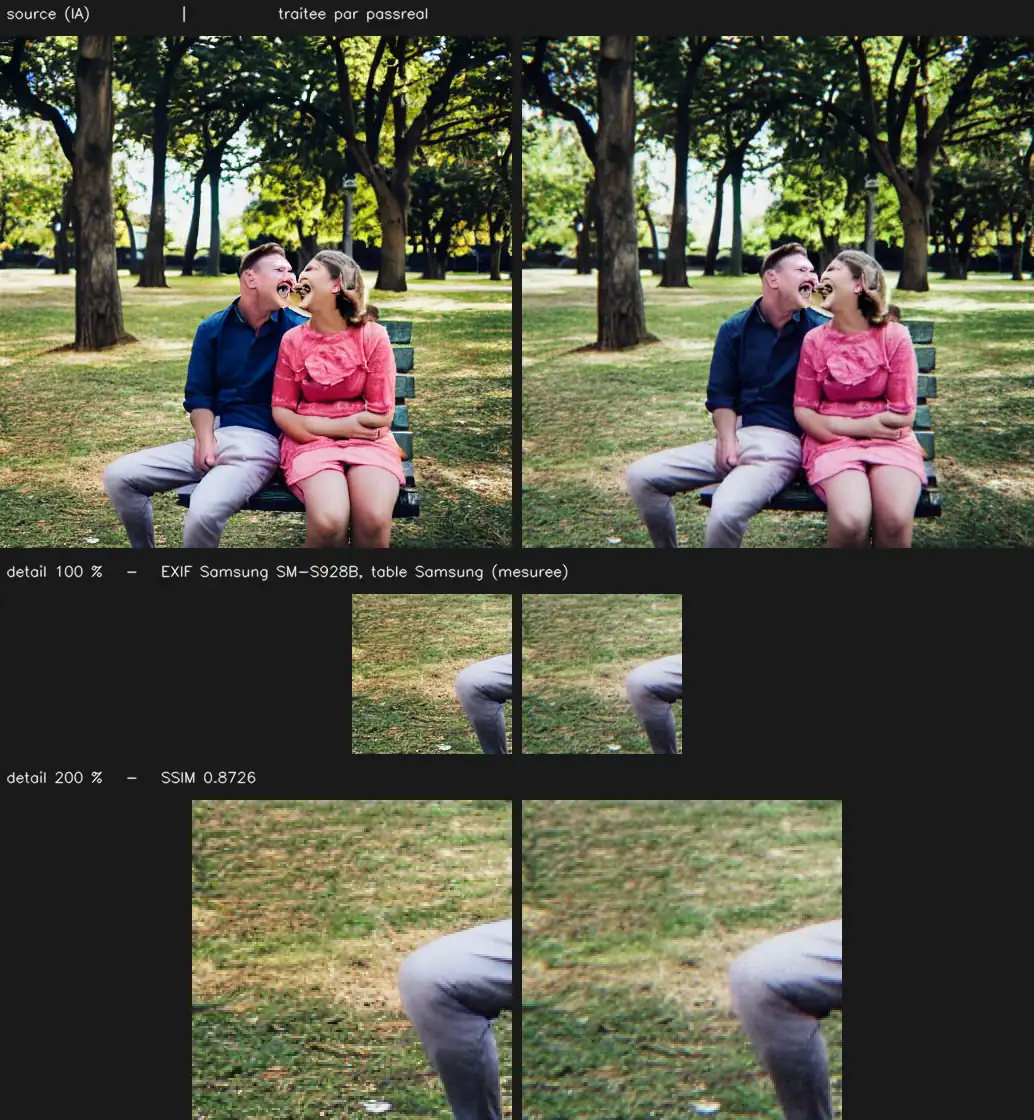
Fidelity here is measured per image - the sheet above gives SSIM and PSNR for this one against its source.
If your goal is a still, work from the highest quality frame
Exporting a frame from a compressed clip gives you an image that has already been through video encoding - macroblocking, chroma subsampling, motion artefacts frozen mid-movement. That residue is a stronger signal than anything the generator left, and no downstream pass removes it.
Export at the highest quality the source allows, from the original file rather than a re-uploaded copy, and prefer a frame with little motion. A still pulled from a platform re-encode carries that platform's compression on top of everything else.
What people usually mean when they search this
Three different problems share one query. Someone wants the corner mark gone from a clip: that is video editing, and cropping is the honest answer. Someone wants a still for a thumbnail or a cover: that is an image problem, and this pipeline applies. Someone wants to know whether SynthID survives: nobody outside Google can answer that with a measurement.
Knowing which one you have saves paying for a tool that solves a different one.
What is measured here
Fidelity is computed per image and reported on the sheet above: SSIM and PSNR against the source for this exact file. Nothing on this site publishes a detection pass rate, because such a figure would describe one detector version on one day and would be stale within the month.
| What is checked | Value |
|---|---|
| Accepted formats | PNG, JPEG, WebP |
| Maximum size | 20 MB |
| Maximum dimension | 8192 px on the longest side |
| Sensor grain intensity | 0.018 |
| Lateral chromatic aberration | 1.25 px at the corners, none at the centre |
| Frequency cutoff | 0.88 of Nyquist |
Questions
Does PassReal remove the Veo watermark from a video?
No. PassReal accepts PNG, JPEG and WebP still images. It does not process MP4 or any video container, so a Veo clip is out of scope. Saying otherwise would be selling something that does not exist.
What about a single frame exported from a Veo clip?
A frame exported as a still is an image, so it goes through the pipeline like any other. The metadata written by the export tool is stripped and camera EXIF is written. The visible corner mark, if it is in the frame, is part of the picture and stays.
Is the visible corner mark the same as SynthID?
No. The corner mark is drawn into the picture and you can see it. SynthID is imperceptible and embedded in the pixel values, read by a paired model. Removing one says nothing about the other.
Why do so many tools advertise Veo and Sora watermark removal?
Because the search demand is large and the visible corner mark can be cropped or inpainted. That addresses what a viewer sees. It does not address SynthID, and most of those tools do not claim it does when read closely.
What is Veo 3 versus Veo 2 here?
Version changes affect quality and duration, not the marking approach: Google has applied SynthID across its generative surfaces from the start. Treat any version the same way.
Limits
Naturalization operates on the pixels and on the file, not on the content of the image. A subject that is implausible - six fingers, inconsistent reflections, text that does not read - stays implausible after processing, and a human reviewer will notice it. PassReal changes what a statistical classifier measures, not what a person sees.
Results vary by generator, by subject and by detector, and detectors are retrained. No pass rate is published on this page because none has been measured in a way that would still hold next month.
Three images, no card, no expiry.